← All courses

Python with Spyder

Learn Python for data and science using the Spyder IDE.

  • 1 month (4 weeks)
  • 20 topics
  • Final exam
Book a trainer
Python with Spyder

Your learning path

4 weeks from start to certificate

  1. 1

    Week 1

    Spyder & Python basics

  2. 2

    Week 2

    Core Python

  3. 3

    Week 3

    Scientific Python

  4. 4

    Week 4

    Project

  5. Finish

    Exam & certificate

Every week

How each week works

Learn

Live class with your trainer

Practice

Guided hands-on exercises

Build

Mini project for your portfolio

Review

Feedback and Q&A

Concept lab

See how the core concepts connect

Follow the path from foundations to real workplace application. Every concept feeds the next project.

1

Week 1

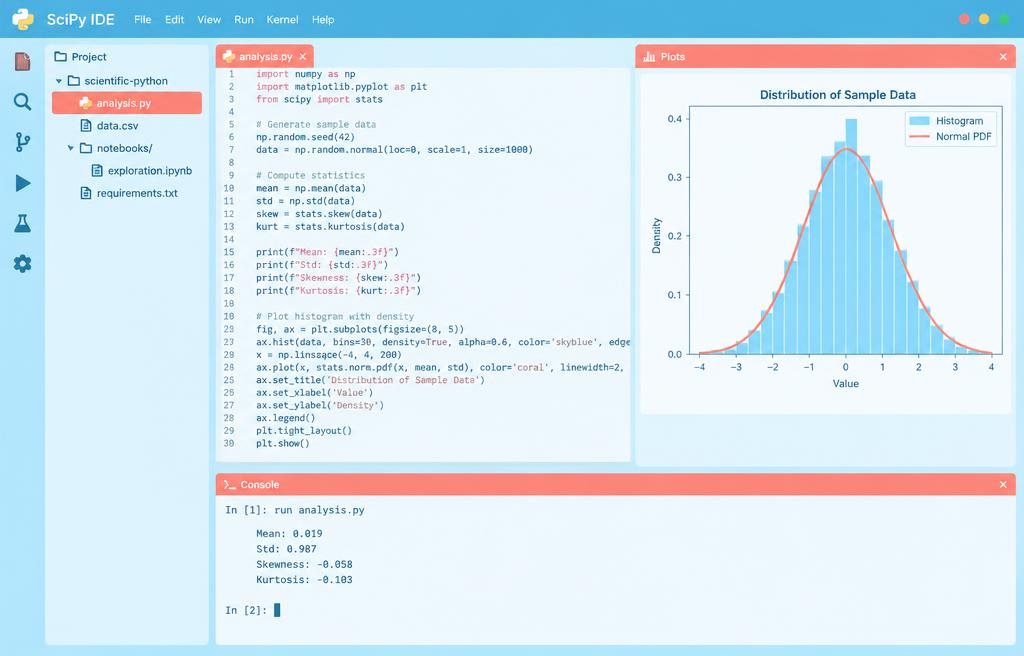
Introduction to Spyder IDE

2

Week 1

First Python Program

3

Week 2

Lists: Ordered Collections

4

Week 2

Tuples, Sets, and Dictionaries

5

Week 3

NumPy: Numerical Computing

6

Week 3

Pandas: Data Analysis

7

Week 4

Project Planning & Design

8

Week 4

Data Acquisition & Preparation

Topics per week

20 topics · 80 lessons
Week 15
Week 25
Week 35
Week 45

Course curriculum

1

Week 1 · 5 topics · 20 lessons

Spyder & Python basics

By the end of this week: Learners will set up their Spyder environment, understand fundamental Python syntax, and execute basic scripts.

  1. 1.1Introduction to Spyder IDE
    • Installation and setup (Anaconda)
    • Interface overview: editor, console
    • Variable Explorer and Plots panes
    • Debugger basics: breakpoints, step
  2. 1.2First Python Program
    • Print function and comments
    • Basic arithmetic operations
    • Running scripts in Spyder
    • Troubleshooting common errors
  3. 1.3Variables and Data Types
    • Assigning values to variables
    • Integers, floats, and strings
    • Booleans and NoneType
    • Type conversion functions
  4. 1.4Input and Output
    • Receiving user input (input())
    • Formatted string literals (f-strings)
    • Concatenation and repetition
    • Printing multiple arguments
  5. 1.5Conditional Logic
    • Comparison operators
    • If, elif, else statements
    • Logical operators: and, or, not
    • Nested conditionals
Week 1
Spyder & Python basics
Introduction to Spyder IDE
First Python Program
Variables and Data Types
Input and Output
Conditional Logic

Hands-on project

Personalized Greeting Script

2

Week 2 · 5 topics · 20 lessons

Core Python

By the end of this week: Learners will master essential data structures, control flow, and code organization with functions.

  1. 2.1Lists: Ordered Collections
    • Creating and accessing elements
    • List methods: append, insert, remove
    • Slicing lists
    • List comprehensions
  2. 2.2Tuples, Sets, and Dictionaries
    • Tuples: immutable sequences
    • Sets: unique unordered elements
    • Dictionaries: key-value pairs
    • Accessing and modifying dictionary items
  3. 2.3Loops and Iteration
    • For loops with lists and ranges
    • While loops: conditions
    • Break and continue statements
    • Enumerate and zip functions
  4. 2.4Functions: Code Reusability
    • Defining and calling functions
    • Parameters and arguments
    • Return values
    • Default and keyword arguments
  5. 2.5File Handling
    • Opening and closing files (with open)
    • Reading text files
    • Writing to text files
    • CSV file basics (reader, writer)
Week 2
Core Python
Lists: Ordered Collections
Tuples, Sets, and Dictionaries
Loops and Iteration
Functions: Code Reusability
File Handling

Hands-on project

Simple Data Analysis Script

3

Week 3 · 5 topics · 20 lessons

Scientific Python

By the end of this week: Learners will utilize powerful scientific libraries for data manipulation, analysis, and visualization.

  1. 3.1NumPy: Numerical Computing
    • N-dimensional arrays (ndarrays)
    • Array creation functions
    • Array operations: arithmetic, slicing
    • Universal functions (ufuncs)
  2. 3.2Pandas: Data Analysis
    • Series and DataFrames
    • Reading data (CSV, Excel)
    • Indexing and selecting data
    • Data cleaning and manipulation
  3. 3.3Data Visualization with Matplotlib
    • Plotting basics: line, scatter
    • Customizing plots: labels, titles
    • Multiple subplots
    • Saving figures
  4. 3.4Advanced Matplotlib/Seaborn
    • Histograms and box plots
    • Heatmaps and pair plots
    • Styling plots with Seaborn
    • Integrating with Pandas DataFrames
  5. 3.5Basic Statistical Operations
    • Mean, median, mode (NumPy/Pandas)
    • Standard deviation, variance
    • Correlation analysis
    • Simple linear regression (SciPy)
Week 3
Scientific Python
NumPy: Numerical Computing
Pandas: Data Analysis
Data Visualization with Matplotlib
Advanced Matplotlib/Seaborn
Basic Statistical Operations

Hands-on project

Interactive Data Exploration

4

Week 4 · 5 topics · 20 lessons

Project

By the end of this week: Learners will independently apply their Python and Spyder skills to complete a practical, data-driven project.

  1. 4.1Project Planning & Design
    • Understanding project requirements
    • Breaking down complex problems
    • Pseudocode and flowcharts
    • Choosing appropriate libraries
  2. 4.2Data Acquisition & Preparation
    • Web scraping (requests, BeautifulSoup)
    • API interaction (e.g., Alpha Vantage)
    • Handling missing values (Pandas)
    • Data type conversions
  3. 4.3Analysis & Modeling
    • Applying statistical techniques
    • Feature engineering
    • Basic machine learning (scikit-learn)
    • Interpreting results
  4. 4.4Visualization & Reporting
    • Creating insightful plots
    • Interactive plots (Plotly/Bokeh)
    • Generating summary reports
    • Exporting results (CSV, PDF)
  5. 4.5Debugging & Best Practices
    • Effective use of Spyder debugger
    • Error handling (try-except)
    • Code style and readability (PEP8)
    • Version control basics (Git)
Week 4
Project
Project Planning & Design
Data Acquisition & Preparation
Analysis & Modeling
Visualization & Reporting
Debugging & Best Practices

Hands-on project

Stock Market Data Analyzer

Final exam & certificate

Finish the 4 weeks, then take the online exam. Score 70% or more to pass.

Job-ready syllabus

Learn it. Build it. Explain it. Use it.

The syllabus goes beyond watching lessons. You practice the tasks employers expect, produce evidence of your skills, and prepare to discuss your work clearly.

Workplace skills

Apply Introduction to Spyder IDE, First Python Program, Variables and Data Types, Input and Output in guided business scenarios.

Portfolio proof

Complete 4 practical projects, including Personalized Greeting Script.

Professional practice

Present your work, respond to feedback, document decisions, and improve the final result.

Interview readiness

Review common role questions and explain your process, tools, trade-offs, and project outcomes.

Your completion pack

Weekly projects, trainer feedback, final assessment, and a certificate you can add to your résumé and LinkedIn profile.

Why learn from us?

Six reasons students pick M - IT Solutions

One-month programs built around live teaching, real projects and support that actually shows up.

Live online classes

Learn with a real instructor in real time — not pre-recorded videos you watch alone.

Hands-on projects

Every week ends with practical work you can show employers on day one.

1-on-1 trainer time

Stuck or want to go deeper? Book private sessions with a trainer whenever you need.

A real learning area

Lessons, progress tracking and exams all live in your account, on any device.

Trusted by companies

We train individuals and whole teams — from small businesses to enterprise programs.

Verified & supported

Verified accounts, real certificates and a support team that answers when you write.

1000+ learners trainedLive, instructor-ledProject-based every week
Home